
How Condition Alone Can Multiply a 1975 Penny’s Value
The market 1975 penny value is determined exclusively by the coin's surface condition, confirmed by official certification.
The vast majority of specimens from this series, having been in circulation for decades, lost their collectible appeal and are valued at face value.
Only a small fraction of the mintage retaining original mint luster and an absence of mechanical damage demonstrates a multiple price progression when transitioning between grades.
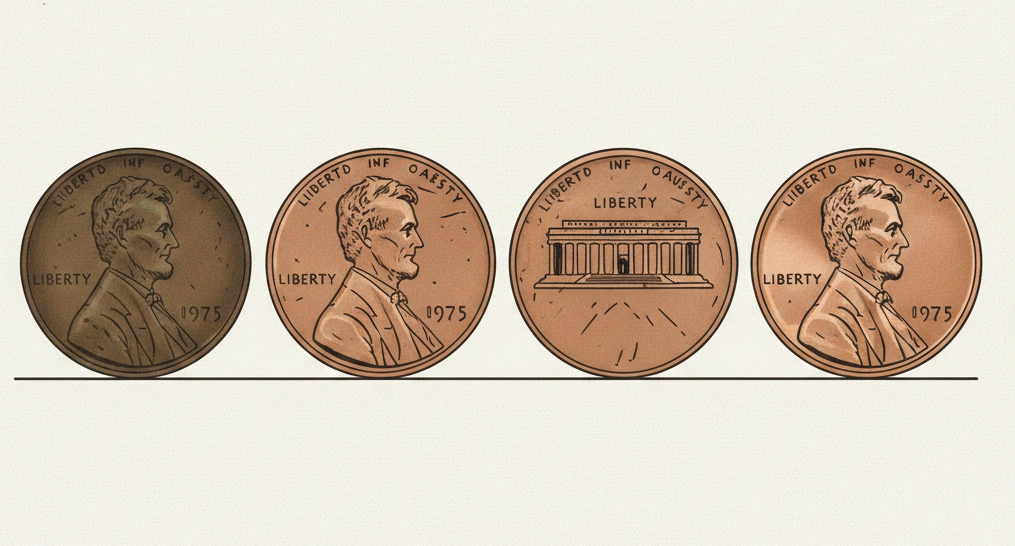
In 1975, the United States Mint used a standard copper-zinc alloy characteristic of the period before 1982.
High copper content provides the coin with significant mass and a characteristic luster affecting the final color classification.
Characteristic | Value |
Composition | 95% copper, 5% zinc and tin |
Weight | 3.11 grams |
Diameter | 19.05 mm |
Edge | Plain |
Designers | Victor D. Brenner (obverse), Frank Gasparro (reverse) |
The 1975 penny's weight of 3.11 grams allows for easy distinction from later zinc issues weighing 2.5 grams.
The condition of the copper layer is critically important for assessment due to copper being susceptible to rapid oxidation under environmental influence.
Mintage Statistics by Mint Facility
Production volume in 1975 reached record levels ensuring market saturation with billions of specimens.
Such mass minting causes fierce competition among high-quality coins where any minimal damage reduces the price dozens of times.
Philadelphia (no mint mark): 3,450,110,000 pieces.
Denver (D): 4,505,275,300 pieces.
San Francisco (S - Proof): 2,845,450 pieces.
In total, over 7.9 billion cents were produced in 1975.
Despite the billion-sized mintages, the number of coins in MS68 condition is measured in single digits, creating a shortage in the upper market segment.
Influence of Color Grading on Value
For 1975 copper coins, color is the primary classification factor before assigning a numerical grade.
Classification is conducted across three categories reflecting the degree of surface oxidation.
Red (RD): The coin retains more than 95% of its original orange-red luster.
Red-Brown (RB): The surface retains between 5% and 95% of its original color.
Brown (BN): Original luster is absent with the surface completely covered by patina.
Prices for RD specimens can be 5–10 times higher than for similar RB coins of the same numerical grade.
Market Value Analysis Based on Condition
The table below reflects the price dynamics for the 1975 cent (Philadelphia) depending on the Sheldon scale.
Data is based on average auction sales performance and coin value app/PCGS/NGC registries.
Grade | Estimated Price (USD) |
MS63 RD | $0.20 - $0.50 |
MS65 RD | $1.00 - $3.00 |
MS66 RD | $15.00 - $25.00 |
MS67 RD | $100.00 - $250.00 |
MS68 RD | $3,000.00+ |
The progression demonstrates exponential value growth upon reaching MS67 condition.
Transitioning from MS67 to MS68 increases the coin's price more than 10 times based on the exceptional rarity of this condition.
Auction Records and Maximum Sales
Maximum price indicators are recorded at Heritage Auctions public sales for coins with the highest grade and flawless color.
Analyzing historical data allows for identifying key sales from recent years.
1975-P MS68 RD (PCGS): Sold in 2018 for $9,000.
1975-D MS67 RD (PCGS): Sold in 2019 for $480.
1975-S PR70 DCAM (PCGS): Sold in 2002 for $4,025.
The presence of the "Deep Cameo" (DCAM) designation for San Francisco Proof coins is a mandatory condition for achieving maximum price.
Statistics show that MS68 grade prices have risen by 15–20% over the last 5 years resulting from a reduction in open market supply.
Production Defects and Errors
Beyond ideal preservation, a 1975 cent's value can be multiplied through rare technological deviations.
During this period, specific types of production waste were recorded at the mints.
Double Die Obverse (DDO): Doubling of date elements or inscriptions occurring during die manufacturing.
Off-Center Strike: Planchet displacement leading to partial image loss (a 50% shift with a full date is worth between $50 and $150).
Blank Planchet: A planchet having passed through the upsetting machine but not receiving a die impression (price around $2–$5).
Mint errors combined with high preservation grades create unique lots with prices determined individually at auction.
Factors Influencing Grade Reduction
Understanding the assessment process requires accounting for defects appearing during the minting and transportation stages.
1975 coins often have characteristic flaws preventing the acquisition of an MS68 grade.
Bag Marks: Scratches and nicks received during coin contact in bags after minting.
Carbon Spots: Black oxidation dots on the copper surface appearing due to metal impurities or moisture.
Weak Strike: A weak die hit resulting in indistinct rendering of Lincoln's hair or memorial columns.
Even a single microscopic oxidation dot on the obverse can lower the grade from MS67 to MS65, reducing the value 50–100 times.
Population Report Dynamics
Grading company data allows for estimating the rarity of conditions in percentage terms.
Analyzing the PCGS registry for 1975 cents (Philadelphia) shows the following figures:
MS65 RD: Over 1,500 specimens.
MS66 RD: Approximately 800 specimens.
MS67 RD: Approximately 120 specimens.
MS68 RD: 2 specimens.
The negligibly small percentage of coins in MS68 condition explains the abnormally high cost of these positions on the market.
Investment Assessment and Liquidity
Considering the 1975 cent as an investment asset, one should focus on the confirmed liquidity of grades.
Coins below MS66 are considered illiquid assets due to high certification costs relative to the market price.
Grading Costs: Shipping and PCGS/NGC service fees range from $30 to $60 per coin.
Spread: The difference between purchase and sale prices for an MS67 grade is approximately 20–30%.
Growth Rates: The average annual value growth of MS67 RD coins over the last 10 years amounted to 3.5%.
Investment in highest grade coins requires a hermetic slab protecting the copper from further darkening.
Self-Identification of Preservation
Performing a preliminary visual analysis is necessary before sending a coin for professional assessment.
But firstly, check the coin at home with the free coin identifier app.
Use a 10x magnifying glass to search for micro-scratches on the coin fields.
Check for the absence of wear on the highest relief points (Lincoln's cheekbone and hair).
Evaluate luster uniformity when rotating the coin under a point light source.
The presence of any sign of being circulated automatically excludes the coin from the category of investment-attractive objects.